The two formulas
annualized = (end ÷ start)1/years − 1
ROI answers "how much did I make?" Annualized return answers "how hard was that money working?" Only the second is comparable between investments.
The same 60%, three different investments
| Investment | Start → End | Years | ROI | Annualized |
|---|---|---|---|---|
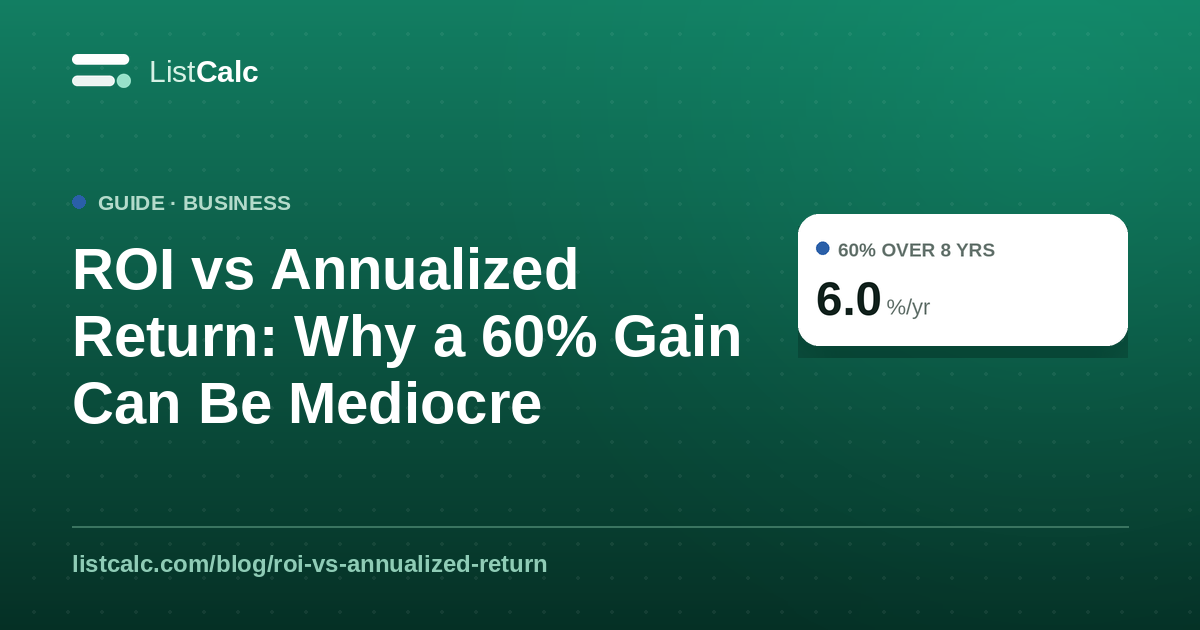
| Investment A | $10,000 → $16,000 | 7 | 60% | 6.94% |
| Investment B | $10,000 → $16,000 | 3 | 60% | 16.96% |
| Investment C | $10,000 → $12,000 | 1 | 20% | 20.00% |
By ROI, C is the worst of the three. By annualized return it is the best. If you can repeat C, it turns $10,000 into $17,280 in three years — beating both.
Then subtract inflation
Nominal returns overstate what you actually gained. The real return is not simply nominal minus inflation — it is a ratio:
Investment A's 6.94% at 3% inflation becomes a real return of 3.83%. Over seven years, $10,000 grew to $16,000 in dollars but only about $13,000 in purchasing power.
What ROI leaves out
- Time. The headline problem, fixed by annualizing.
- Cash flows in between. Simple ROI cannot handle deposits and withdrawals mid-period. That requires IRR or a money-weighted return.
- Risk. A 12% annualized return from government bonds and 12% from a single startup are not the same achievement.
- Costs and taxes. Fees, commissions and capital gains all reduce what you keep. Compare after-cost figures or you are comparing nothing.
A quick sanity check
Use the Rule of 72 in reverse. Divide 72 by the years taken to double: an investment that doubles in 10 years earned about 7.2% a year; one that doubles in 20 years earned about 3.6%. If a deal cannot beat that back-of-envelope test, the detailed spreadsheet will not save it.
For a picture of what those rates do over decades, see what regular investing compounds into — and on the business side, margin and markup is the other percentage pair that is routinely confused with expensive results.
Run your own numbers
FAQ
What is the difference between ROI and annualized return?
How do I calculate annualized return?
What is a good ROI?
Should I account for inflation in ROI?
Does ROI work for business investments?
Sources
Primary references used for the figures and rules on this page.
- Compound Interest Calculator — U.S. SEC — Investor.gov
- Introduction to Investing — U.S. SEC — Investor.gov